Long-Travel Piezo Motor Positioning
PI miCos piezo stages use stick-slip, ultrasonic, and piezo-walk/grabber motor principles to combine compact dimensions with millimeter-scale travel. Linear and rotary versions are guided by precision bearings and can use high-resolution optical encoders for closed-loop positioning.
Flexure-Guided Nanopositioning
For the highest precision, frictionless piezo-flexure stages with capacitive feedback provide repeatable sub-nanometer motion, very fast settling, high scanning rates, and extremely long service life. These systems are suited to microscopy, metrology, photonics, semiconductor, and other precision applications.
Linear Precision Piezo Stages
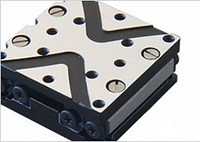
Linear- Travel: 13 or 26 mm
- Maximum load: 0.2 kg
- Blocking force: 2 N
- Maximum speed: 10 mm/s
- Resolution: <1 nm
- Repeatability: to 20 nm
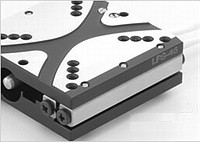
Linear- Travel: 13 or 26 mm
- Maximum load: 1 kg
- Maximum speed: 10 mm/s
- Encoder resolution: <2 nm
- Repeatability: to 50 nm
- Optional linear encoder
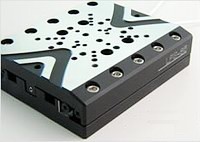
Multi-Axis- Travel: 13, 26, or 52 mm
- Maximum load: 1 kg
- Maximum speed: 10 mm/s
- Encoder resolution: <2 nm
- Repeatability: to 1 nm
- Optional linear encoder
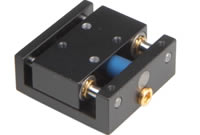
Linear- Travel: 8–30 mm
- Maximum load: 0.8 kg
- Maximum speed: 2 mm/s
- Resolution: 1.5 nm
- Repeatability: 10 nm unidirectional
- Optional linear encoder
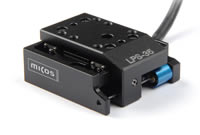
Linear- Travel: 6.5–38 mm
- Maximum load: 0.8 kg
- Maximum speed: 0.5 mm/s
- Resolution: 0.05 µm
- Repeatability: 0.03 µm unidirectional
- Optional linear encoder
Rotary & Tip/Tilt Piezo Stages
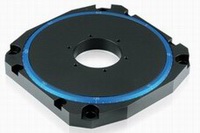
Rotary- 360° endless rotation
- Maximum load: 2 kg
- Maximum speed: 720°/s
- High-resolution piezo motor drive
- Compact precision rotary positioning
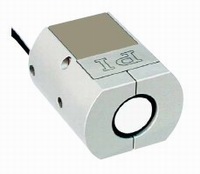
Tip/Tilt- Two-axis rotation, up to 60 mrad
- Single common pivot point
- Millisecond response
- Resonant frequency to 3 kHz
- Optional angular encoder
Need More Precision?
PI's flexure-guided nanopositioning stages extend performance into the sub-nanometer range with frictionless guidance, capacitive sensors, high dynamics, and scanning rates of hundreds of hertz. Explore current PI nanopositioning systems →